
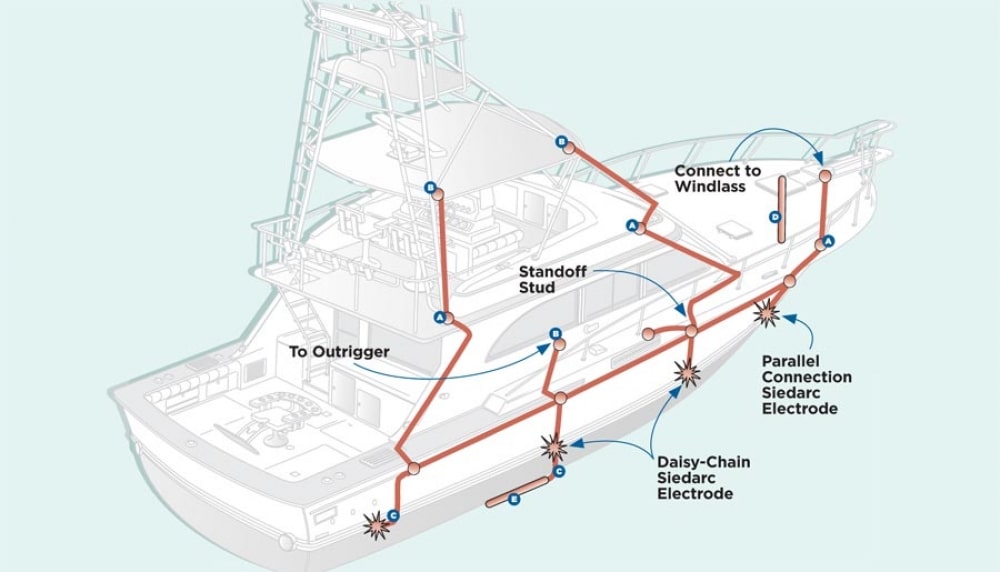
Florida is the lightning capital of the United States. According to BoatUS Marine Insurance data, roughly one-third of all lightning-related marine insurance claims originate in Florida, and estimates suggest that between 4% and 20% of moored sailboats in the state will be struck in any given year. Lightning doesn't care what kind of boat you have. Sailboats, trawlers, center consoles, bass boats — if you're the highest point on the water, you're the target. And the damage isn't limited to a scorch mark on the mast. We're talking melted wiring harnesses, blown-out hulls, and fried electronics that turn a $50,000 helm station into a paperweight.
The question isn't whether your boat will ever be near a lightning strike. In Southwest Florida, it's when. The real question is what happens next — and that's entirely within your control.
You Can't Stop It. You Can Control It.
Most boat owners think about lightning protection backward. They want a shield — something that prevents the strike from happening. That's not how it works. If mother nature decides it's your turn, no amount of rubber boots or disconnected antennas will change the outcome.
The correct approach is to build a highway, not a shield. Give that massive electrical charge — 300 million volts at 55,000 degrees Fahrenheit, hotter than the surface of the sun — a safe, purpose-built, super-low-resistance path from the top of the boat straight through and safely out into the water. That's what a Lightning Protection System (LPS) does.
The ABYC standard TE-4 (Lightning Protection) and NFPA 780 (Standard for the Installation of Lightning Protection Systems) both establish the framework for how this should be done on recreational vessels. The principle is straightforward: provide a continuous, low-impedance conductor path from the highest point of the boat to a grounding plate below the waterline.
Three Components of a Lightning Protection System
A properly installed LPS has three main parts, and each one has a specific job:
| Component | Function | Details |
|---|---|---|
| Air Terminal | The catcher's mitt | Mounted at the highest point of the vessel — masthead on sailboats, hardtop or arch on powerboats. Provides the initial point of contact for the strike. |
| Down Conductor | The superhighway | Heavy-gauge copper conductor (minimum #4 AWG per ABYC TE-4) running from the air terminal to the grounding plate. Must be as straight and short as possible — no sharp bends, no coils. |
| Grounding Plate | The off-ramp | A large copper plate mounted below the waterline. Its job is to be the easiest, most attractive exit point for the electrical charge — so the lightning doesn't carve its own path through the hull. |
When all three components are properly installed and bonded, the strike enters at the air terminal, travels down the conductor, and exits through the grounding plate into the water. The boat becomes a safe conductor instead of a victim. Without this system, the lightning will find its own path — and that path often goes through wiring, through-hulls, or straight through the fiberglass hull from the inside out.
How Lightning Damages a Boat
A lightning strike isn't one event — it's a complex chain of destruction that happens in multiple ways simultaneously:
Direct Strike Damage
The bolt hits the highest point and that energy rips through the boat looking for the fastest way to reach the water. On a fiberglass or wood boat — both terrible conductors — the surge can get violent. We've seen strikes blow holes through fiberglass hulls from the inside out. That hole wasn't from hitting a rock. It was blasted through by electricity that couldn't find an easy exit.
Side Flash
This is the one that puts people at risk. The main bolt is traveling down the mast, but then it sees a better, easier path nearby — a metal handrail, the engine block, or a person. The charge can literally jump across air to reach that new path. This is why you never touch two separate metal objects at the same time during a storm. You could become the bridge for a side flash.
Electromagnetic Pulse (EMP)
The silent killer of modern marine electronics. A strike creates a massive, invisible magnetic shockwave that radiates outward. It doesn't need to touch anything — any wire it passes over gets a surge of electricity induced in it, frying anything connected. A boat that gets hit 100 feet away can still have every piece of electronics destroyed. Your chartplotter, radar, autopilot, VHF, AIS — all of it is vulnerable. One strike can turn a glass helm into a very expensive paperweight.
Protecting Your Electronics: The EMP Problem
Modern boats carry more processing power than early spacecraft, and all of it is incredibly vulnerable to electromagnetic pulse. The LPS handles the main bolt, but you need a separate strategy for the EMP. Here are the proven countermeasures:
- Faraday cages — Metal cabinets for critical electronics, bonded to the vessel's grounding system, create a shielded enclosure that blocks electromagnetic fields. Purpose-built marine Faraday enclosures are available, but even a properly bonded metal locker provides significant protection.
- Surge protectors — Install marine-rated surge protection on every circuit feeding electronics. These won't stop a direct hit, but they absorb the induced surges from nearby strikes.
- Disconnect when possible — Unplugging electronics before a storm removes them from the circuit entirely. No wire connection means no path for induced current.
- The oven trick — For handheld GPS, VHF, and other portable electronics, place them in the oven before a storm. The metal box of a marine oven acts as a makeshift Faraday cage. It sounds unconventional, but it works.
Busting the Myths
Two myths persist in the boating community that need to be put to rest:
Myth #1: "Lightning is only a sailboat problem"
Dead wrong. If you're on the water in a bass boat, center console, trawler, or anything else, you can be the highest point — and that makes you the target. Sailboats get more attention because their masts are tall, but powerboats are struck regularly. Any vessel on open water during a thunderstorm is at risk.
Myth #2: "Lightning never strikes the same place twice"
On the water, it absolutely can and will hit the same spot again and again. Tall structures — including masts, outriggers, and T-tops — are repeat targets. If your boat was struck once, it's not immune. It's proven attractive.
Personal Safety: What to Do When You're Caught
All the equipment protection in the world means nothing if the people on board aren't safe. If you're caught in a thunderstorm on the water, the goal is simple: make yourself a terrible conductor of electricity.
- Get down low — Reduce your profile. Crouch if you have to.
- Stay in the middle of the boat — Away from the rails, stays, and metal fittings at the edges.
- Keep everything inside the rails — No fishing rods, no arms draped over the side.
- Stop swimming immediately — Water is a conductor. Get out and get aboard.
- Avoid touching metal — Don't hold the wheel, don't lean on the rail.
- Never touch two metal objects at once — This is the most critical rule. Holding a metal wheel while leaning against a metal rail makes you the bridge for a side flash. That's how people get seriously hurt.
The old-timers had a phrase that covers it: "Make yourself small, stay quiet, and just let the storm pass." That's still the best advice.
The Bottom Line
Any boat on the water during a storm is a potential target. You can't change that. The only choice you have is what happens next. Is that strike a complete disaster — melted wiring, blown-out hull, fried electronics, injured crew? Or is it a non-event that gets safely guided through the boat and into the water?
A properly designed and installed lightning protection system turns your boat from a victim into a safe conductor. The components are straightforward — air terminal, down conductor, grounding plate — and the standards (ABYC TE-4, NFPA 780) are well established. The real question is whether your boat has one.
Need a Lightning Protection Assessment?
Captain Roland and the ACCUMAR Marine Services team inspect and install lightning protection systems throughout Southwest Florida. We'll assess your vessel's current grounding and bonding, identify gaps, and recommend the right system for your boat type and size. We service Fort Myers, Cape Coral, Naples, Sanibel, Marco Island, and Punta Gorda.
Call us at 239-323-9600 or book a service call.

