A marine watermaker offers the ultimate freedom for offshore cruising, transforming seawater into clean, fresh drinking water and allowing you to stay off-the-grid longer. However, these systems rely on high-pressure reverse osmosis (RO)—often operating between 800 and 950 psi—to force water through microscopic membrane pores. Because of the intense pressures and the highly corrosive marine environment, a watermaker is not a "set-and-forget" appliance. Neglecting a cheap filter can easily destroy a multi-thousand-dollar high-pressure pump or membrane.
At Accumar Marine Services, we've serviced watermaker systems across Southwest Florida—from Fort Myers and Cape Coral to Naples, Marco Island, and Sarasota—for over 25 years. Here is your essential guide to maintaining your boat's watermaker for reliable, long-term performance.
1. The First Line of Defense: Pre-Filtration
Before seawater ever reaches the delicate RO membrane, it passes through a series of pre-filters designed to catch sediment and marine life.
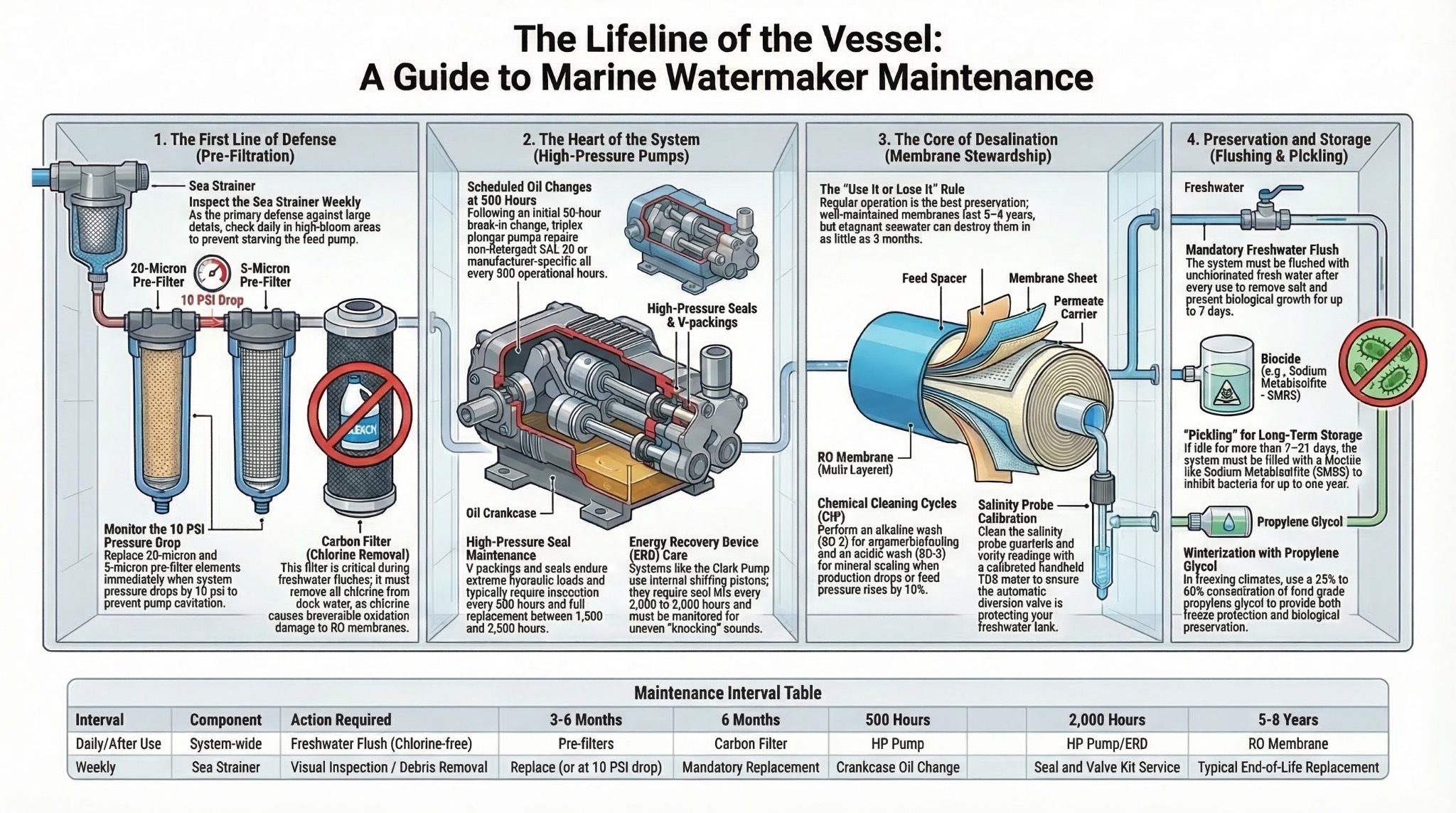
- Check the Sea Strainer: Your sea strainer catches large debris like seaweed, jellyfish, and plastic. If this becomes clogged, it will starve your pump of water and trigger a low-pressure shutdown.
- Replace Micron Filters: Systems typically use 20-micron and 5-micron filters to trap fine particulates. Change these when you notice a drop in system pressure or a decrease in product water flow.
- Smart Operation: A good rule of thumb is to run your watermaker when the water looks clear or blue. While you can make water in silty, murky harbors, doing so will rapidly plug your filters and introduce foul odors from decaying plankton.
Pro Tip: In Southwest Florida's warm waters, biological growth on pre-filters happens faster than in cooler climates. Check your micron filters every 100 hours of operation—not just when pressure drops.
2. The Golden Rule: Fresh Water Flushing (FWF)
The absolute most critical maintenance task for any watermaker is the Fresh Water Flush. Seawater contains microscopic life; if left stagnant inside your system for more than a few days, these organisms consume the remaining oxygen, die, and begin to rot. This biological decay creates a sulfurous "rotten egg" smell and quickly fouls the RO membranes.
- Flush Regularly: You must flush the system with fresh water after every use, or at least every 5 to 7 days if the watermaker is sitting idle.
- Beware of Chlorine: Town or marina tap water often contains chlorine, which will irreparably damage your RO membrane. Always ensure your flush water passes through a specialized carbon (charcoal) filter to neutralize any chlorine before it reaches the membrane. Replace this carbon filter every six months.
Pro Tip: Florida municipal water is heavily chlorinated. If you're dockside at a Fort Myers or Naples marina and using city water for flushing, a carbon pre-filter is not optional—it's mandatory to protect your membrane.
3. Long-Term Layups: Pickling and Winterizing
If you plan to leave your boat and cannot perform a fresh water flush every week, the watermaker must be "pickled" to kill biological growth and protect the membrane.
- Standard Piston Pumps: For traditional systems, the most common pickling agent is a 1% to 2% solution of food-grade Sodium Metabisulfite (SMBS).
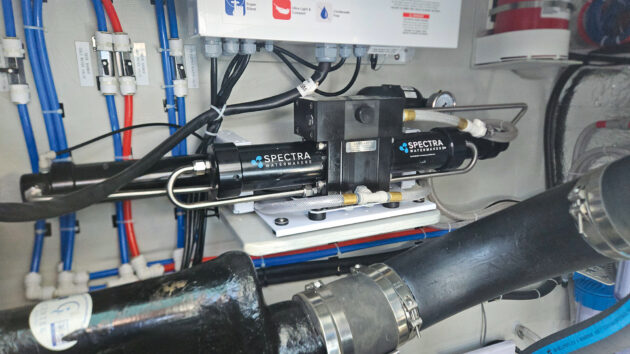
- Energy Recovery Pumps: Do not use SMBS in energy recovery watermakers (such as Spectra or Schenker systems), as it will permanently damage the pump's internal components. Instead, use the manufacturer's proprietary storage chemicals (like Spectra's SC-1).
- Freezing Climates: Pickling chemicals will not prevent the water inside your system from freezing and cracking the pressure vessels. If winterizing in a cold climate, circulate a high-concentration (60% or higher), alcohol-free, food-grade Propylene Glycol through the system.
4. Chemical Clean-In-Place (CIP)
Avoid cleaning your membranes unnecessarily, as excessive chemical exposure can shorten their lifespan. A Clean-In-Place (CIP) is generally only required when your feed pressure rises by 15% or your fresh water production drops by 10%.
When a cleaning is necessary, follow the correct sequence:
- Alkaline Cleaners (e.g., SC-2, Sodium Hydroxide): Always use these first to break down biological fouling, biofilm, grease, and oils.
- Acid Cleaners (e.g., SC-3, Citric Acid): Use these next to dissolve mineral scaling and calcification. Never use acid first on a biologically fouled membrane, as it can harden the biological slime and permanently ruin the membrane.
Pro Tip: Southwest Florida's warm Gulf waters promote faster biological growth on membranes. If you're making water daily in summer, expect to need a CIP cleaning more frequently than boaters in cooler regions.
5. Mechanical Maintenance: Pumps and Motors
The high-pressure pump is the mechanical heart of your watermaker and requires routine attention:
- Oil Changes: If your system uses a high-pressure triplex plunger pump, drain and replace the crankcase oil annually, or every 500 hours of operation (typically using an SAE 30 or ISO 100 oil).
- Impeller Checks: The low-pressure lift/boost pump often utilizes a rubber impeller. Inspect it regularly and replace it every 500 to 1,000 hours, or immediately if the fins look swollen or cracked. A worn impeller restricts flow, causing the high-pressure pump to dangerously cavitate.
- Vibration and Leaks: High-pressure pumps vibrate intensely. Regularly inspect all hoses, O-rings, and mounting hardware to ensure nothing has vibrated loose or started to chafe.
6. Carry a Strategic Spares Kit
If you are cruising offshore, a well-stocked spares kit is not optional—it's a necessity.
- Consumables: Carry at least a year's worth of 20-micron and 5-micron pre-filters, carbon flush filters, pickling chemicals, pump oil, and alkaline/acid cleaners.
- Wear Items: Pack a high-pressure pump seal rebuild kit, replacement lift pump impellers, assorted O-rings, and a spare drive belt.
- Extended Voyages: For remote cruising, carrying a spare RO membrane, vacuum-sealed and stored in a cool place, is excellent insurance.
Brands We Service in Southwest Florida
Accumar Marine Services has hands-on experience with all major watermaker brands found on vessels in the Fort Myers, Naples, Cape Coral, Marco Island, and Sarasota areas:
- Spectra Watermakers — Energy-recovery systems (Ventura, Newport, Catalina series)
- Schenker Watermakers — Energy-recovery desalinators (Zen, Smart series)
- Sea Recovery — High-output commercial and yacht systems
- Village Marine Tec — Compact and modular systems
- Rainman — Portable and semi-portable units
- Parker / HRO (Sea Exchange) — Hydraulic-driven systems
Whether you need routine filter changes, membrane replacement, pump rebuilds, or a full system commissioning, our technicians can handle it. View our service rates or contact us to schedule watermaker service.
The Bottom Line
By treating your marine watermaker with care, utilizing clean feed water when possible, and sticking strictly to your flushing and maintenance schedules, you can expect your system to reliably produce pristine drinking water for a decade or more. The cost of preventive maintenance is a fraction of the cost of replacing a fouled membrane ($500–$2,000+) or rebuilding a seized high-pressure pump ($1,500–$4,000+).
Accumar Marine offers preventive maintenance programs that include watermaker service as part of our Comprehensive Vessel Maintenance Program—starting at $2,750/year for vessels under 40 feet. Don't wait for your watermaker to fail mid-cruise. Call us at 239-323-9600 to schedule service.
Frequently Asked Questions
Q: How often should I flush my marine watermaker in Southwest Florida?
A: In Florida's warm waters, flush your watermaker with fresh water after every use or at minimum every 5 days. The warm Gulf temperatures accelerate biological growth inside idle systems. Always use a carbon filter when flushing with marina tap water to remove chlorine.
Q: Can I use the same pickling solution for all watermaker brands?
A: No. Standard piston-pump systems use Sodium Metabisulfite (SMBS), but energy-recovery watermakers like Spectra and Schenker require manufacturer-specific chemicals (e.g., Spectra SC-1). Using SMBS in an energy-recovery system will permanently damage the pump internals.
Q: How much does watermaker maintenance cost in Fort Myers?
A: Basic watermaker service (filter replacement, flush system check, pressure test) starts around $175/hour plus parts. A full annual service including oil change, impeller inspection, and membrane performance test typically runs $400–$800 depending on the system. Emergency watermaker repair is $220/hour.
Q: How do I know when my RO membrane needs replacing?
A: Replace the membrane when product water quality drops below acceptable TDS levels (typically above 500 ppm) even after a proper CIP cleaning, or when production volume drops more than 15% from baseline despite clean pre-filters and correct operating pressure.
Q: Does Accumar Marine service watermakers on boats at my dock?
A: Yes. We provide mobile watermaker service throughout Southwest Florida—Fort Myers, Cape Coral, Naples, Marco Island, Punta Gorda, and Sarasota. We come to your dock, marina, or boatyard. Contact us to schedule.