Lead-acid batteries have powered boats for over a century, and they still dominate the marine market for good reason — they're proven, affordable, and repairable. But unlike lithium batteries that are largely "set and forget," lead-acid batteries demand regular maintenance. Skip it, and you'll be buying new batteries every 1-2 years instead of getting the 5-7 year lifespan they're designed for.
At ACCUMAR Marine Services, we've maintained and replaced thousands of marine batteries across Fort Myers, Cape Coral, Naples, and Southwest Florida over 25+ years. This guide covers everything you need to know about keeping your lead-acid marine batteries performing at their best.
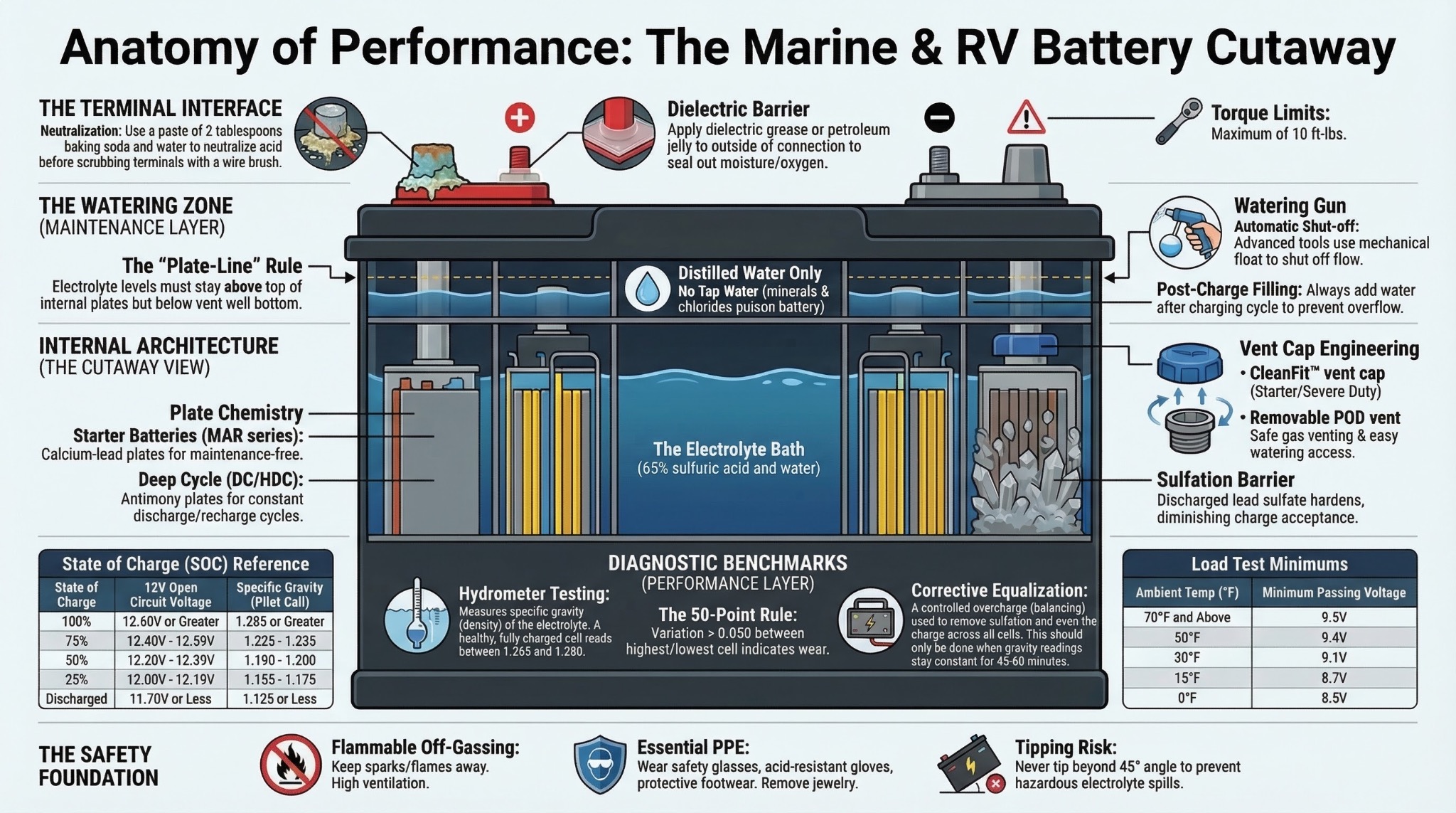
The Terminal Interface: Where Power Meets the Boat
Battery terminals are the connection point between stored energy and your boat's electrical system. Corroded or loose terminals cause voltage drops, starting failures, and can even start fires.
Terminal Neutralization
Acid vapor and electrolyte splash create corrosion on terminals and cable ends. The fix is simple: mix 2 tablespoons of baking soda with water to create a paste, apply it to the terminals, and scrub with a wire brush. The baking soda neutralizes the sulfuric acid on contact. Rinse with fresh water and dry thoroughly.
Dielectric Barrier
After cleaning, apply dielectric grease or petroleum jelly to the outside of the terminal connection. This seals out moisture and oxygen — the two ingredients that cause corrosion. Do not apply grease between the terminal and cable clamp (that would increase resistance).
Torque Limits
Over-tightening terminal bolts cracks the battery case or damages the internal post seal. Maximum torque: 10 ft-lbs. Use a torque wrench, not a ratchet with your full arm strength.
The Watering Zone: Keeping Electrolyte at the Right Level
The electrolyte inside a lead-acid battery is a solution of 65% sulfuric acid and 35% water. During charging, water is consumed through electrolysis (split into hydrogen and oxygen gas). If the electrolyte level drops below the top of the lead plates, those exposed plates sulfate permanently and lose capacity.
The Plate-Line Rule
Electrolyte levels must stay above the top of the internal plates but below the vent well bottom. On most batteries, this means about 1/4 to 1/2 inch above the plate tops. If you can see the plates, the battery is already damaged — add water immediately and charge slowly.
Distilled Water Only
Never use tap water. Minerals and chlorides in tap water poison the battery chemistry, coat the plates, and permanently reduce capacity. Use only distilled water, available at any grocery store for about $1 per gallon.
Post-Charge Filling
Always add water after the charging cycle, not before. During charging, the electrolyte expands and the specific gravity changes. Adding water before charging risks overflow, which washes acid out of the battery and onto your boat — corroding everything it touches.
Watering Tools
A battery watering gun with automatic shut-off is the best investment for battery maintenance. Advanced models use a mechanical float to shut off flow at exactly the right level. No guessing, no overfilling, no acid burns. For battery banks with 4+ batteries, a watering system with quick-connect manifolds saves significant time.
Internal Architecture: Starter vs. Deep Cycle
Not all lead-acid batteries are built the same. Understanding the internal differences explains why they need different maintenance approaches.
Starter Batteries (MAR Series)
Starter batteries use calcium-lead plates designed to deliver a massive burst of current for a short duration (cranking your engine). The calcium additive makes them largely maintenance-free — they consume less water during charging. However, they cannot tolerate deep discharges. Drawing a starter battery below 50% state of charge repeatedly will kill it fast.
Deep Cycle Batteries (DC/HDC Series)
Deep cycle batteries use antimony-lead plates designed for constant discharge and recharge cycles — powering your house loads, trolling motor, windlass, and electronics. The antimony makes the plates more durable under cycling but causes higher water consumption. Deep cycle batteries need their water checked more frequently than starter batteries.
Vent Cap Engineering
Battery vent caps serve two critical functions: allowing hydrogen gas to escape during charging and providing access for watering.
- CleanFit vent caps (Starter/Severe Duty): Designed for minimal maintenance with built-in flame arrestors.
- Removable POD vents: Found on deep cycle batteries. These provide safe gas venting and easy watering access. Remove them for watering, replace them snugly after.
Sulfation: The Silent Battery Killer
When a lead-acid battery discharges, lead sulfate crystals form on the plates — this is normal chemistry. When you recharge, those crystals dissolve back into the electrolyte. But if a battery sits discharged for extended periods, the lead sulfate hardens into permanent crystals that won't dissolve during normal charging. This is sulfation, and it's the #1 cause of premature battery death on boats.
Prevention: Keep batteries charged. If your boat sits at the dock, use a quality marine battery charger (we recommend Victron Energy chargers) set to the correct battery type. If storing for the season, charge fully and disconnect.
Diagnostic Benchmarks: State of Charge Reference
Knowing your battery's state of charge (SOC) tells you whether it's healthy or dying. Two methods: voltage reading and hydrometer testing.
State of Charge by Voltage (12V Battery, Resting)
| State of Charge | 12V Open Circuit Voltage | Specific Gravity |
|---|
| 100% | 12.60V or Greater | 1.285 or Greater |
| 75% | 12.40V - 12.59V | 1.225 - 1.235 |
| 50% | 12.20V - 12.39V | 1.190 - 1.200 |
| 25% | 12.00V - 12.19V | 1.155 - 1.175 |
| Discharged | 11.70V or Less | 1.125 or Less |
Important: Voltage must be measured with the battery at rest — no charging, no loads — for at least 2 hours after disconnecting. A battery under charge will read artificially high; a battery under load will read artificially low.
Hydrometer Testing: The Gold Standard
A hydrometer measures the specific gravity (density) of the electrolyte in each individual cell. A healthy, fully charged cell reads between 1.265 and 1.280. This is more accurate than voltage because it tests each cell independently.
The 50-Point Rule
If the variation between your highest and lowest cell readings exceeds 0.050 (50 points), the battery has a weak or failing cell. Example: if one cell reads 1.275 and another reads 1.220, that's a 0.055 spread — the battery is on its way out.
Corrective Equalization: Balancing the Cells
Equalization is a controlled overcharge used to remove sulfation and even the charge across all cells. It pushes the battery to a higher voltage (typically 15.5-16.2V for a 12V battery) for 45-60 minutes, which forces the sulfate crystals off the plates and mixes the electrolyte through gassing.
When to equalize: Only when hydrometer readings show cell-to-cell variation and the specific gravity readings stay constant for 45-60 minutes during normal charging (indicating the charger can't push the cells any further).
Warning: Equalization produces heavy gassing (hydrogen and oxygen). Ensure maximum ventilation. Never equalize sealed/AGM/gel batteries — only flooded lead-acid.
Load Test Minimums
A load test applies a heavy draw to the battery and measures how well it holds voltage. This is the definitive test for whether a battery can actually start your engine or power your house loads.
| Ambient Temp (°F) | Minimum Passing Voltage |
|---|
| 70°F and Above | 9.5V |
| 50°F | 9.4V |
| 30°F | 9.1V |
| 15°F | 8.7V |
| 0°F | 8.5V |
In Southwest Florida, you're almost always testing at 70°F+, so 9.5V is your minimum passing voltage under load.
The Safety Foundation
Lead-acid batteries contain sulfuric acid and produce explosive gases. Respect them.
Flammable Off-Gassing
During charging, batteries produce hydrogen gas — which is highly flammable and lighter than air. Keep sparks, flames, and cigarettes away from battery compartments. Ensure your battery compartment has adequate ventilation. On boats, this is especially critical in enclosed engine rooms.
Essential PPE
When working on batteries, wear safety glasses, acid-resistant gloves, and protective footwear. Remove all jewelry — a ring or watch band that bridges a terminal to ground will instantly weld to the metal and cause severe burns.
Tipping Risk
Never tip a flooded lead-acid battery beyond 45°. Electrolyte will spill from the vent caps, causing acid burns and corrosion damage to everything it contacts. When transporting batteries, keep them upright and secured.
When to Replace vs. Maintain
Not every battery is worth saving. Replace your marine battery when:
- Hydrometer shows more than 50-point spread between cells after equalization
- Battery fails a load test after full charge
- Case is cracked, bulging, or leaking
- Battery is more than 5 years old and showing capacity loss
- Sulfation is visible on plates (white crystalline buildup) and equalization doesn't restore capacity
ACCUMAR Marine carries and installs marine batteries from leading manufacturers. We also install and configure Victron Energy battery monitors and chargers so you can track your battery health in real time from your phone.
Schedule Marine Battery Service
Whether you need a battery bank inspection, new battery installation, charging system diagnostics, or a complete marine electrical upgrade — we come to your dock throughout Fort Myers, Cape Coral, Naples, Marco Island, and Southwest Florida.
Frequently Asked Questions
Q: How often should I check the water level in my marine batteries?
A: Check monthly at minimum. Deep cycle batteries under heavy use (liveaboards, fishing charters) should be checked every 2 weeks. In Southwest Florida's heat, water consumption increases — batteries evaporate faster in 95°F engine rooms.
Q: Can I use a car battery charger on my boat batteries?
A: A basic car charger will work in an emergency, but it won't properly maintain marine batteries long-term. Marine batteries need a multi-stage charger with bulk, absorption, and float modes. We recommend Victron Energy chargers — they support multiple battery chemistries and can be monitored via Bluetooth.
Q: What's the difference between AGM and flooded lead-acid batteries?
A: Flooded batteries have liquid electrolyte that requires watering. AGM (Absorbed Glass Mat) batteries have the electrolyte absorbed in fiberglass mats — they're sealed, maintenance-free, and spill-proof. AGM costs more upfront but requires zero watering. Both are lead-acid chemistry; the maintenance differences are significant.
Q: How much does marine battery replacement cost in Fort Myers?
A: Battery prices vary by type and capacity. A quality Group 27 deep cycle marine battery runs $150-$250. Group 31 batteries run $200-$350. Installation including terminal cleaning, cable inspection, and charger verification is typically 1-2 hours of labor. See our rate schedule for current pricing.
Q: Does ACCUMAR Marine service battery systems at my dock?
A: Yes. We provide mobile marine electrical service throughout Fort Myers, Cape Coral, Naples, Marco Island, Pine Island, Punta Gorda, and Sarasota. We come to your dock, marina, or boatyard. Contact us to schedule.