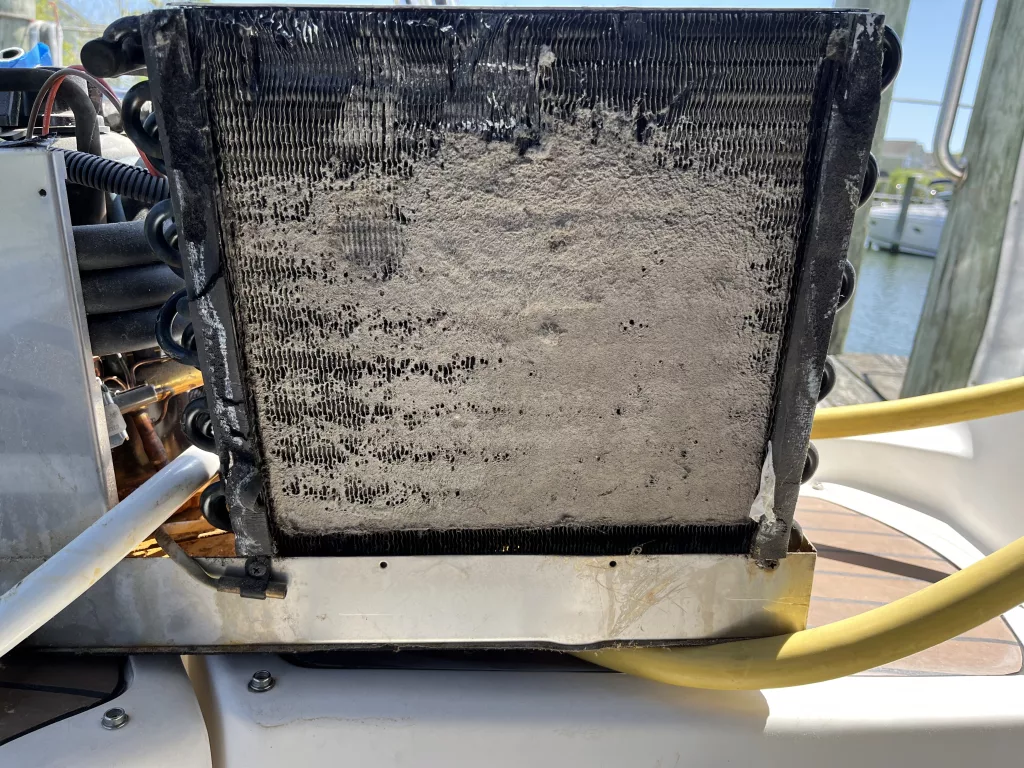
Your marine air conditioning system is not a household unit bolted to a boat. It's a seawater-cooled machine fighting salt, marine growth, humidity, and corrosion every hour it runs. The difference between a system that lasts 15 years and one that dies in 3 comes down to maintenance — specifically, the maintenance most boat owners skip.
At ACCUMAR Marine Services, we've repaired and maintained marine AC systems across Fort Myers, Cape Coral, Naples, Marco Island, and all of Southwest Florida for over 25 years. This guide covers the four pillars of marine AC maintenance that keep your system running at peak performance.
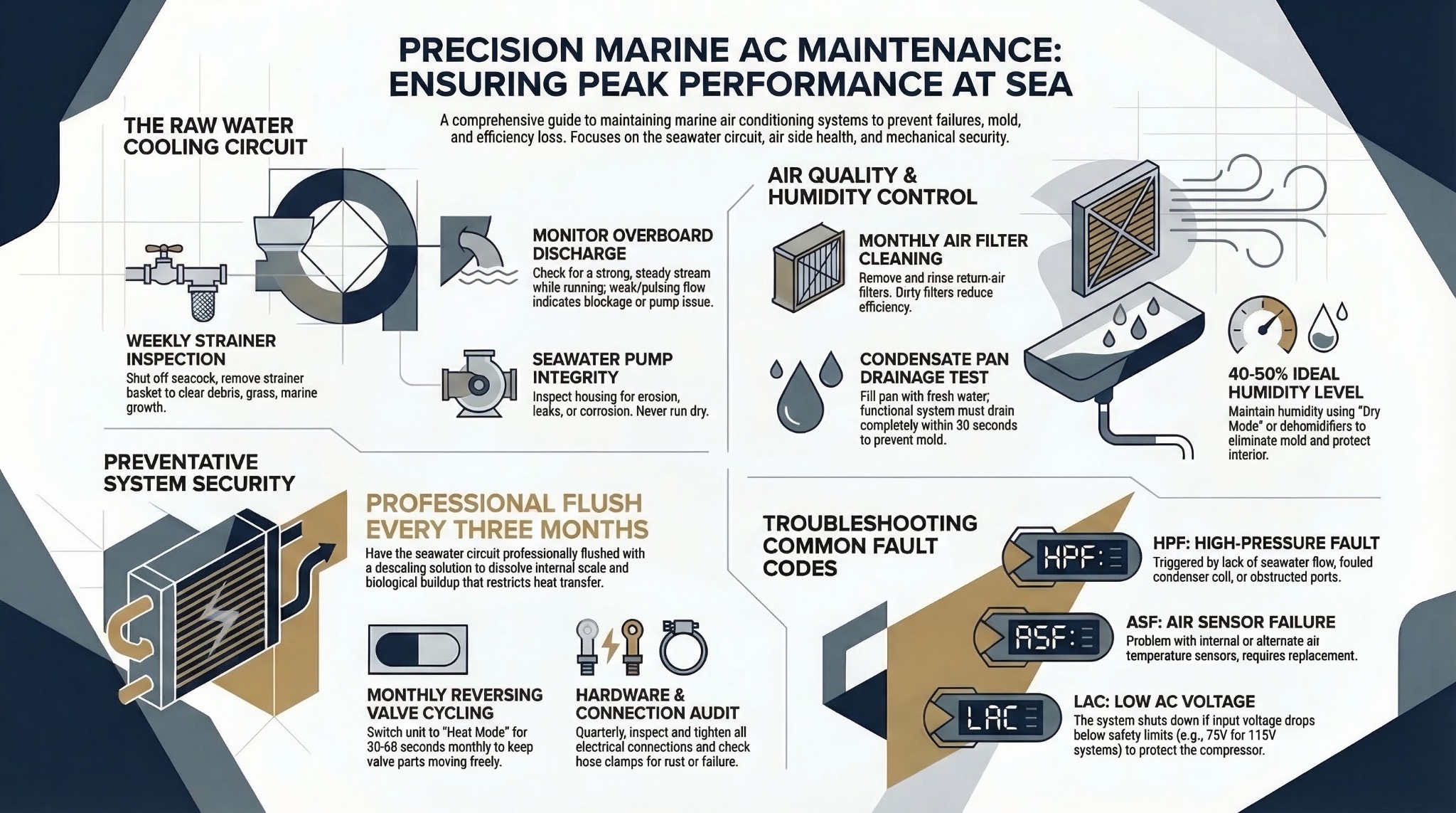
1. The Raw Water Cooling Circuit
Unlike your home AC that dumps heat into the air, a marine AC system dumps heat into the ocean via a raw water (seawater) cooling circuit. This is the most maintenance-intensive part of the system because you're pumping corrosive, biologically active seawater through your boat.
Weekly Sea Strainer Inspection
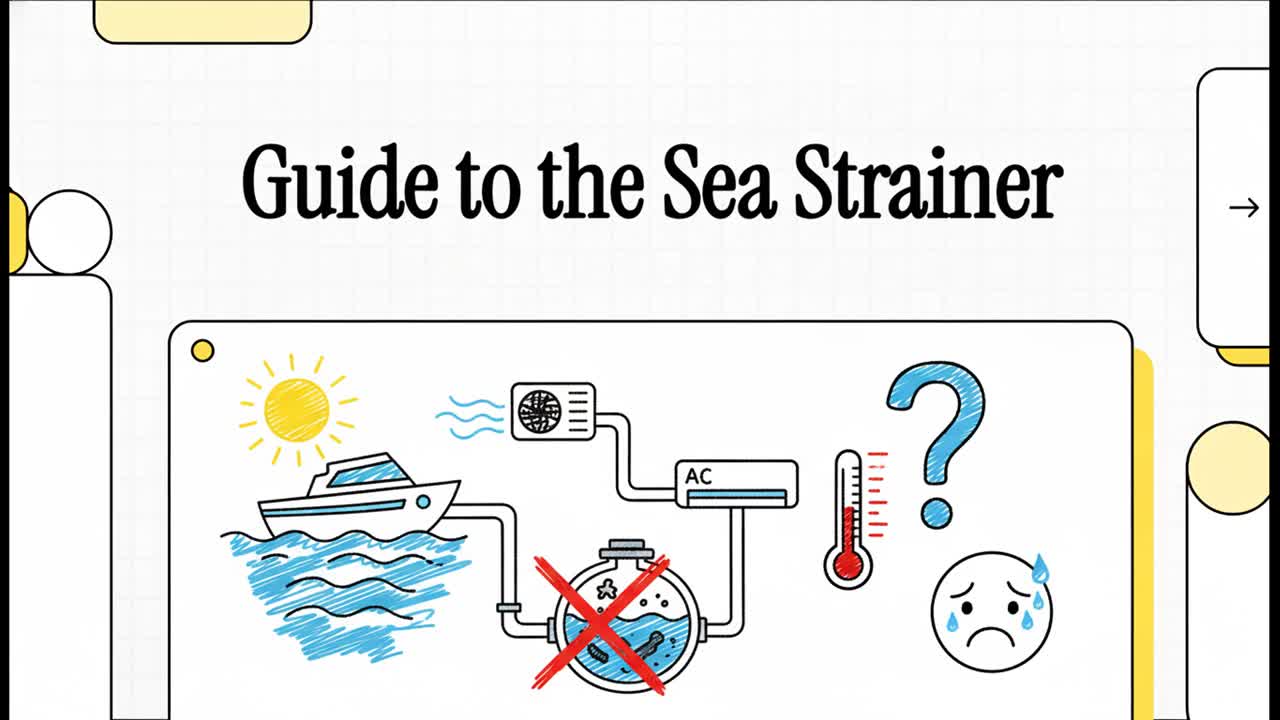
The sea strainer is the first line of defense between the ocean and your AC system. Shut off the seacock, remove the strainer basket, and clear all debris — seaweed, grass, barnacles, jellyfish, and marine growth. In Southwest Florida's warm waters, biological fouling happens fast. A clogged strainer starves the pump, triggers a high-pressure fault, and can cascade into a compressor failure.
For a deep dive on sea strainer maintenance, read our complete sea strainer maintenance guide.
Monitor Overboard Discharge
While the AC is running, check the overboard discharge (the water stream coming out of the hull). You should see a strong, steady stream. A weak, pulsing, or intermittent flow indicates a blockage in the strainer, a failing pump impeller, or a restriction in the seawater circuit. Don't ignore this — it's the earliest warning sign of trouble.
Seawater Pump Integrity
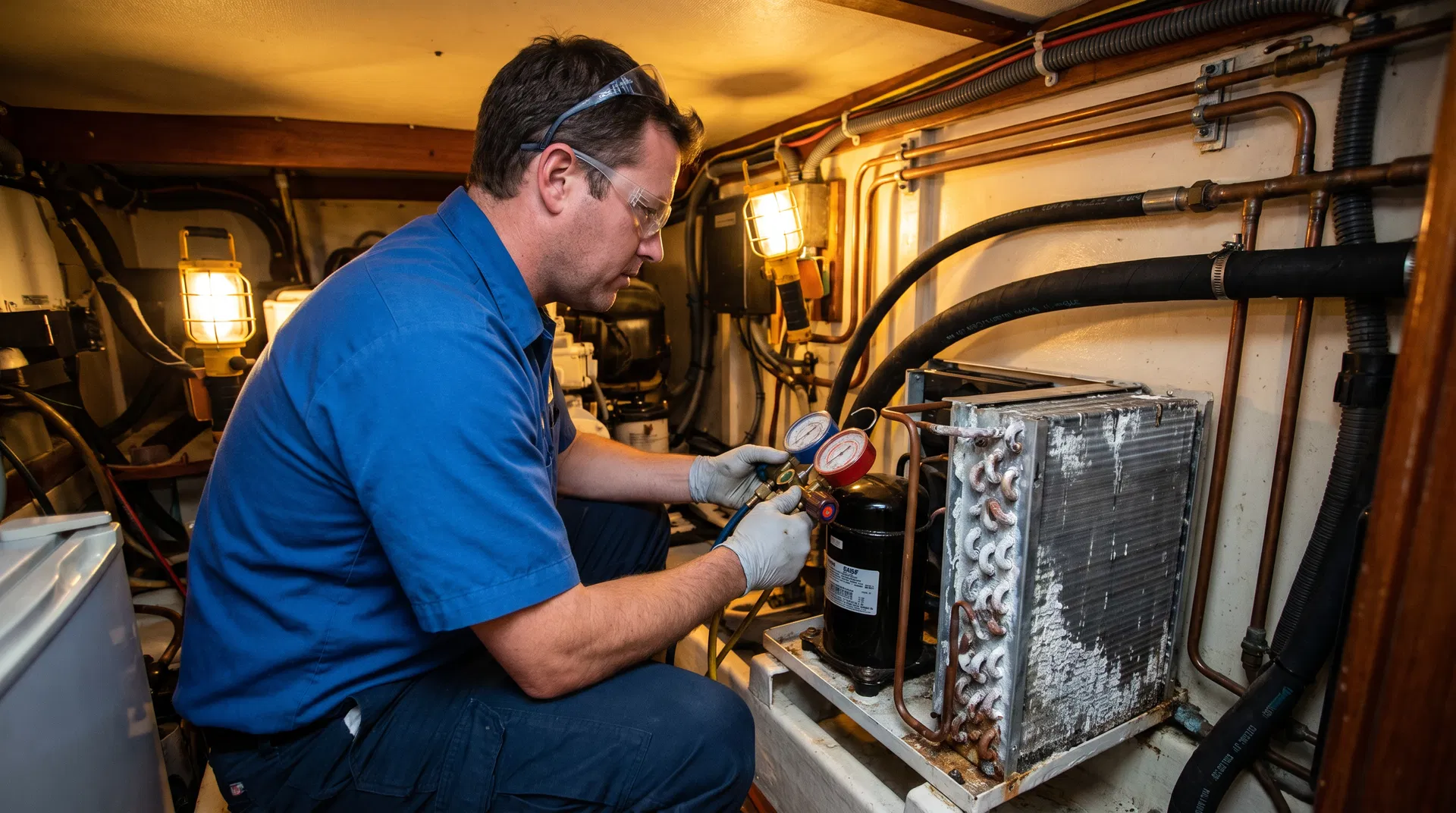
The raw water pump is the heart of the cooling circuit. Inspect the housing for erosion, leaks, and corrosion. Check the impeller for worn or missing vanes. A March pump with a degraded impeller will still move some water, but not enough to properly cool the condenser — leading to high head pressure and reduced cooling capacity.
Critical rule: Never run the pump dry. Even 30 seconds of dry running can destroy a rubber impeller and score the pump housing. Always verify the seacock is open before powering on the AC.
2. Air Quality & Humidity Control
The air side of your marine AC is where comfort meets health. Neglect it and you get mold, musty odors, and reduced cooling — plus potential respiratory issues for everyone aboard.
Monthly Air Filter Cleaning
Remove and rinse the return-air filters monthly. Dirty filters restrict airflow, reduce efficiency, and force the system to work harder. In a marine environment, filters collect salt spray, dust, pet hair, and cooking grease faster than you'd expect. Most marine AC filters are reusable — just rinse with fresh water and let dry before reinstalling.
Condensate Pan Drainage Test
The condensate pan catches moisture that drips off the evaporator coil. If the drain line is clogged, water backs up, overflows, and creates a mold factory inside your AC unit and cabin liner.
Test it: Fill the condensate pan with fresh water. A functional system must drain completely within 30 seconds. If it's slow or doesn't drain, the line is clogged — clear it with a wet/dry vacuum or compressed air. In Southwest Florida's humidity, condensate drain issues are one of the top 3 service calls we get.
40-50% Ideal Humidity Level
Marine environments are inherently humid. Your goal is to maintain cabin humidity between 40% and 50%. Above 60%, mold starts growing on every surface — headliner, cushions, electronics, and inside the AC ducting itself.
Solutions: Use your AC's "Dry Mode" (dehumidification mode) when the boat is unoccupied. For boats in storage or on the hard, a standalone marine dehumidifier is essential. In Fort Myers' summer humidity (80%+ outside), a boat without active dehumidification will grow mold within days.
3. Preventative System Security
These are the maintenance tasks that prevent expensive failures — the ones most boat owners don't know about until something breaks.
Professional Flush Every Three Months
Have the seawater circuit professionally flushed with a descaling solution (like Barnacle Buster or Rydlyme) to dissolve internal scale and biological buildup that restricts heat transfer. In Southwest Florida's warm Gulf waters, calcium scale and biofilm accumulate inside the condenser coil and seawater lines faster than in cooler regions.
ACCUMAR Marine includes quarterly descaling flushes in our AC Maintenance Program — it's one of the most cost-effective things you can do to extend system life.
Monthly Reversing Valve Cycling
If your marine AC has a heat pump function (most do), the reversing valve switches between cooling and heating modes. If you only use cooling (which is most of the year in Southwest Florida), the reversing valve can seize from corrosion and mineral deposits.
Prevention: Switch the unit to "Heat Mode" for 30-60 seconds monthly to keep the valve parts moving freely. This takes 60 seconds and can save you a $500-$800 reversing valve replacement.
Hardware & Connection Audit
Quarterly, inspect and tighten all electrical connections and check hose clamps for rust or failure. Marine vibration loosens connections over time. A loose wire on a compressor contactor causes arcing, which burns the contactor and can trip breakers or start fires. Check hose clamps on all seawater connections — stainless steel clamps corrode in salt air, and a failed clamp means seawater flooding your bilge.
4. Troubleshooting Common Fault Codes
Modern marine AC controllers display fault codes when something goes wrong. Here are the three most common codes we see on service calls in Southwest Florida and what they mean.
HPF: High-Pressure Fault
What it means: The refrigerant pressure on the discharge (hot) side of the compressor has exceeded the safety limit. The controller shuts down the compressor to prevent damage.
Common causes:
- Lack of seawater flow (clogged strainer, failed pump impeller, closed seacock)
- Fouled condenser coil (scale buildup restricting heat transfer)
- Obstructed overboard discharge port (marine growth blocking the thru-hull)
First response: Check the sea strainer, verify the seacock is open, and confirm strong overboard discharge flow. If the strainer is clear and flow is good, the condenser likely needs a descaling flush.
ASF: Air Sensor Failure
What it means: The controller has lost communication with the internal or alternate air temperature sensor.
Common causes:
- Damaged or disconnected sensor wire
- Failed thermistor (the sensor element itself)
- Corroded connector at the control board
First response: Check the sensor wire connection at the control board. If the connection is clean and secure, the sensor likely needs replacement — a straightforward repair that takes under an hour.
LAC: Low AC Voltage
What it means: The system shuts down because input voltage has dropped below the safety limit (typically 75V for 115V systems) to protect the compressor. Running a compressor on low voltage causes overheating and premature failure.
Common causes:
- Undersized shore power cord or extension cord
- Overloaded marina power pedestal (common in busy Southwest Florida marinas)
- Corroded shore power connections
- Generator voltage regulation issues
First response: Check voltage at the AC panel with a multimeter. If voltage is low at the pedestal, contact the marina. If voltage is fine at the pedestal but low at the boat, inspect shore power cords and inlet connections for corrosion or damage.
The Cost of Skipping Maintenance
Here's what we see when boat owners skip these maintenance items:
| Skipped Maintenance | Typical Failure | Repair Cost |
|---|
| Sea strainer inspection | Compressor failure from overheating | $1,500 - $3,500 |
| Descaling flush | Condenser coil replacement | $800 - $2,000 |
| Condensate drain clearing | Mold remediation + headliner replacement | $2,000 - $5,000+ |
| Reversing valve cycling | Seized reversing valve replacement | $500 - $800 |
| Connection audit | Burned contactor / electrical fire risk | $300 - $1,200 |
Total potential cost of neglect: $5,100 - $12,500+. Total cost of annual preventive maintenance with ACCUMAR Marine: starting at $2,750/year for vessels under 40 feet, which includes AC service as part of our Comprehensive Vessel Maintenance Program.
Schedule Marine AC Maintenance
Whether you need a one-time AC service call, a quarterly descaling flush, or a full annual maintenance program — we come to your dock throughout Fort Myers, Cape Coral, Naples, Marco Island, and Southwest Florida.
Frequently Asked Questions
Q: How often should I have my marine AC serviced in Southwest Florida?
A: At minimum, a professional service twice per year — once before summer season and once mid-season. The seawater circuit should be descaled every 3 months in Southwest Florida's warm waters. Weekly sea strainer checks and monthly filter cleaning should be done by the boat owner.
Q: What does HPF mean on my marine AC controller?
A: HPF stands for High-Pressure Fault. It means the refrigerant discharge pressure exceeded the safety limit, usually caused by insufficient seawater flow. Check your sea strainer first — it's the #1 cause. If the strainer is clear, the condenser coil likely needs a descaling flush.
Q: Why does my boat smell musty even with the AC running?
A: Musty smell indicates mold growth, usually in the condensate pan, drain line, or evaporator coil. The condensate pan should drain completely within 30 seconds — if it doesn't, the drain is clogged. Also check that cabin humidity stays below 50%. In Fort Myers' summer humidity, mold can establish in 48 hours on a boat without active dehumidification.
Q: How much does marine AC maintenance cost in Fort Myers?
A: A standard AC service call (inspection, strainer cleaning, filter check, performance test) is available starting at $160 per hour. A descaling flush is typically $250-$400 depending on the number of units. Our annual maintenance program starts at $2,750/year for vessels under 40 feet and includes AC service. See our rate schedule.
Q: Should I run my marine AC when the boat is at the dock?
A: In Southwest Florida, yes — at least in dehumidification ("Dry") mode. The humidity will destroy your interior, electronics, and upholstery if left unchecked. If you can't run the AC, use a standalone marine dehumidifier. The cost of running the AC is far less than the cost of mold remediation.