HomeNews & InsightsHow to Clean & Maintain Your Marine AC Sea Strainer: The Captain's Complete Guide
Air Conditioning
How to Clean & Maintain Your Marine AC Sea Strainer: The Captain's Complete Guide
Your marine AC sea strainer is the gatekeeper between the ocean and your air conditioning system. Learn the 8-step cleaning process, the bromine hack for biofouling prevention, annual acid descaling, and why a clogged strainer can cascade into a five-figure repair. Based on 25+ years of field experience in Fort Myers and Southwest Florida.
Roland — ACCUMAR Marine Technical StaffMarch 22, 2026
When you hop in your car and press the AC button, cold air just happens. It's a sealed, pressurized loop of refrigerant — completely isolated from the outside world. But the moment you step onto a boat, that expectation of sealed, predictable comfort is completely shattered. On a boat, you're not just cooling the cabin — you are actively fighting the ocean to do it.
At ACCUMAR Marine Services, we've spent 25+ years repairing marine AC systems across Fort Myers, Cape Coral, Naples, and all of Southwest Florida. The single most common cause of AC failure we see? A neglected sea strainer. This guide breaks down exactly what happens when you ignore it, how to clean it properly, and the advanced prevention tactics veteran captains use to stay ahead of the ocean.
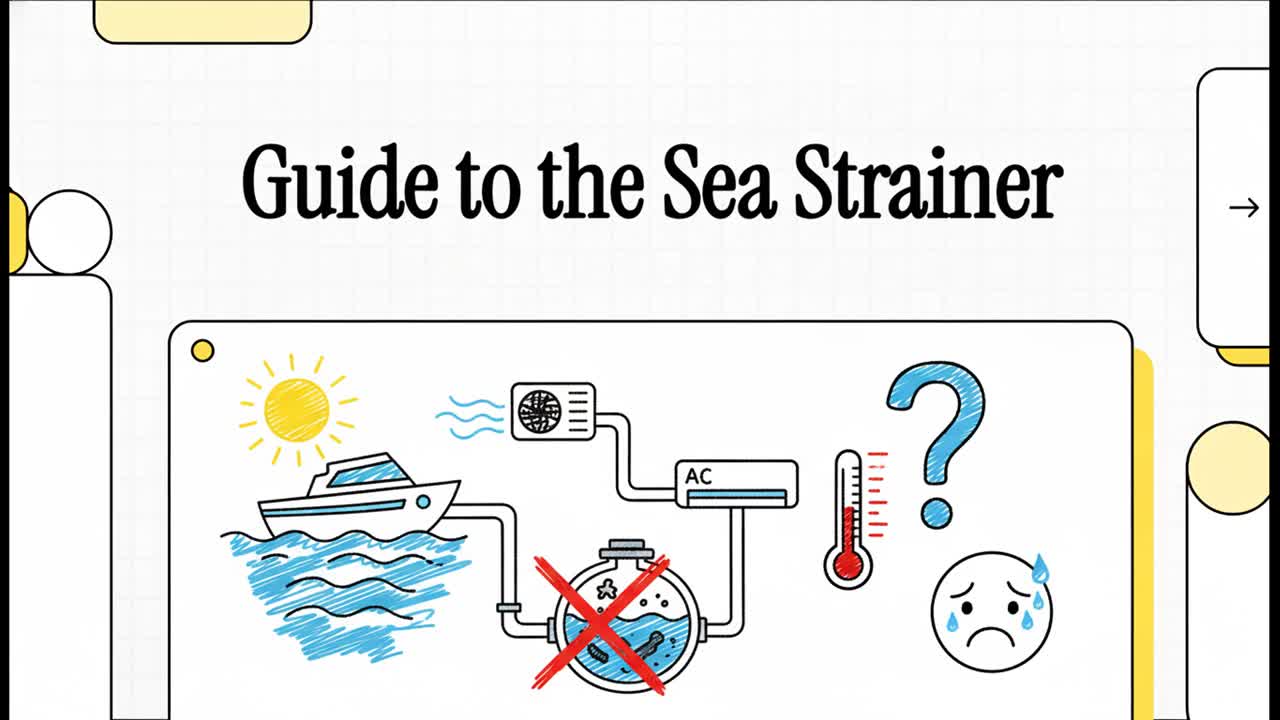
Watch: Guide to the Marine AC Sea Strainer — 5-minute whiteboard walkthrough covering the complete cleaning process, the bromine hack, and acid descaling.
Why Marine AC Uses Seawater (Not Air)
Water transfers heat roughly 25 times more efficiently than air. A marine AC system capitalizes on this by using a dedicated water pump to pull raw seawater from under the hull, push it through a heat exchanger where it absorbs the intense heat pulled from your cabin, and then spit that hot water overboard. It's brilliant engineering — but it relies on a constant, unimpeded flow of seawater.
Seawater isn't just water. It's a biologically active, highly corrosive soup of seagrass, floating plastic, barnacle larvae, and mineral deposits. If you let all of that flow directly into the delicate internal plumbing of your AC unit, you wouldn't have air conditioning for very long.
What the Sea Strainer Actually Does
The sea strainer sits directly between the intake valve (the seacock on the bottom of your hull) and the water pump. It is literally your first line of defense — a physical bouncer at the door, filtering out debris before it hits your pump's impeller. Think of it like the lint trap on a home dryer, except the stakes are entirely different.
If you ignore your dryer's lint trap, your clothes come out damp. If you ignore your boat's sea strainer, you trigger a catastrophic cascade effect:
Restricted water flow — the AC unit can't cool its high-pressure refrigerant
System temperature spikes — triggers an automatic shutdown (HPF or low-flow error code)
Pump runs dry — the impeller spins at thousands of RPMs without water cooling, generating intense localized heat
Internal components melt — the thermoplastic wet-end components soften, distort, and fuse together
Back pressure blows seals — partial restrictions force water to find the weakest link in your plumbing
Saltwater floods the bilge — a blown hose clamp means an open pipe connected directly to the ocean
Corrosive salt residue — evaporating saltwater leaves crystalline sulfates that destroy copper wiring, generator terminals, and battery posts
Real-World Example: A boater named Jose Torres documented tearing apart his sailboat's AC pump after it started leaking. Over a two-year period, tiny barnacle fragments — looking like coarse grains of sand — had bypassed the strainer basket, lodged inside a high-pressure thimble, created so much back pressure that the pump blew its seals and started leaking backwards.
How Often Should You Check Your Sea Strainer?
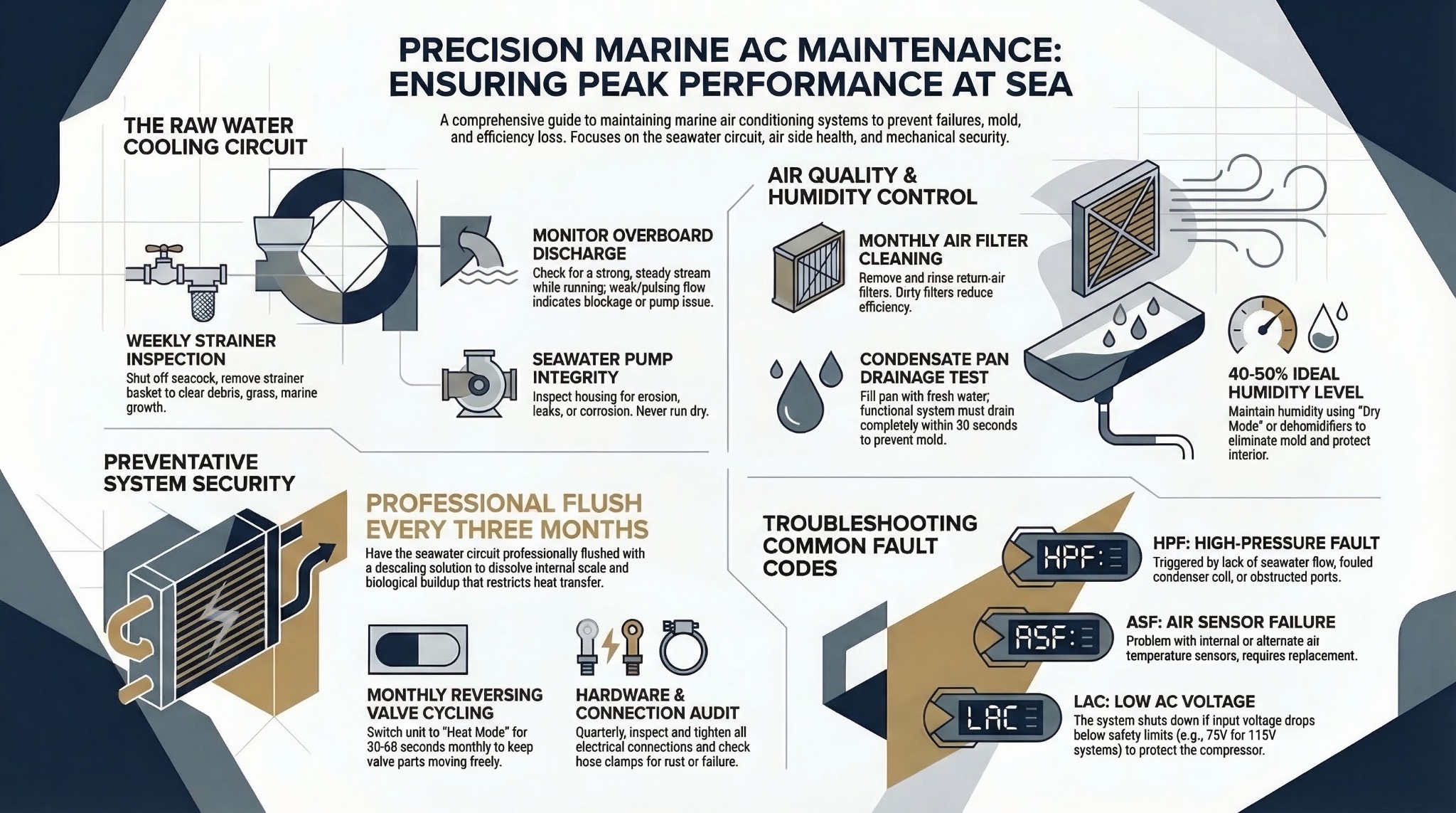
The official Dometic Passport manual suggests checking the sea strainer monthly in the summer. Most captains laugh at this. A calendar means nothing to the ocean — marine growth is dictated entirely by local water conditions, temperature, and tidal flow.
Fort Lauderdale, FL: Weekly cleaning is mandatory. In those high summer water temperatures, biofouling accelerates exponentially. Skip a week and it's choked with algae.
Tarpon Springs, FL (Gulf Coast): Constant west winds blow thick floating mats of seagrass into marinas. Some boaters clean their strainer every 2-3 days depending on wind direction.
Fort Myers & Cape Coral: Our local waters are warm and nutrient-rich. Fertilizer runoff causes algae blooms. Barnacle mating season adds another layer. We recommend weekly visual inspections at minimum.
Your grime schedule is written by your coordinates, not a manual. You have to learn your local ecosystem.
Step-by-Step: How to Clean Your Marine AC Sea Strainer
Here is the master-class 8-step process synthesized from S&S Dockside, March Pumps engineering guides, and Dometic manufacturer manuals:
Step 1: Kill the Power at the Breaker
Turn off the AC at the main electrical breaker — not just the thermostat. If the cabin gets warm while you're working and the thermostat calls for cooling, it will send power to the pump while the system is dismantled.
Step 2: Close the Seacock
This is the most critical safety action. The seacock is the heavy-duty bronze valve attached directly to the hull. It is the only thing standing between you and the ocean. If you unscrew the lid of the sea strainer without closing that valve first, the pressure of the ocean will push a geyser of water straight into your boat. Ensure the handle is turned completely perpendicular to the flow of the hose.
Step 3: Remove the Strainer Basket
Unscrew the top of the housing and pull out the strainer basket. These baskets are usually rated at a 40-mesh size (40 holes per linear inch) — the perfect balance between trapping debris and allowing the massive volume of water required by the pump to pass through.
Step 4: Clean the Basket
Dump the grass, scrub the scale, and remove all biofouling from the basket. Gross but necessary.
Step 5: Inspect the Basket Integrity
Check for warped plastic or torn stainless steel mesh. If there is a gap, debris will take the path of least resistance around the filter — which is exactly how barnacle fragments end up destroying pump internals.
Step 6: Manage the O-Ring
March Pumps states explicitly that a misaligned, pinched, or dirty O-ring is the primary cause of system failure after maintenance. Even a single grain of coarse sand on that rubber ring prevents the lid from seating perfectly. If the lid doesn't seat, the vacuum is broken — and the pump will suck air through the gap instead of water.
Step 7: Reopen the Seacock
With the clean basket reinstalled and the lid properly sealed, reopen the seacock to allow seawater back into the system.
Step 8: Power On and Verify Flow
Turn the AC breaker back on, run up to the deck, and immediately look over the side of the hull at the overboard discharge. You want to see a steady, solid, aggressive stream of water. If it's a weak, pulsing trickle, you still have a flow restriction or a partial airlock.
Pro Tip: If you hear a smooth hum but see no water discharge, your pump is cavitating — it's airlocked. Shut off the power, close the seacock, open the strainer lid, and pour a pitcher of water into the housing until it overflows into the intake hose. You're manually displacing the air with heavy water. Seal it, reopen the seacock, and try again.
The Bromine Hack: Preventing Biofouling
Several veteran captains on boating forums swear by taking a standard 1-inch bromine spa tablet (the kind you buy for a hot tub) and dropping it directly into the sea strainer basket after cleaning. As seawater flows through the housing, it slowly dissolves the tablet, introducing a continuous microscopic dose of bromine through the entire raw water system.
This essentially turns the environment inside your hoses and heat exchanger toxic to algae and microscopic larvae. It stops biofouling before it can attach to the walls.
Critical Warning: Do NOT substitute bromine with chlorine. They're both halogens, but chlorine is vastly more aggressive:
Concentrated chlorine will rapidly degrade the clear plastic housing and eat away at rubber O-rings, causing catastrophic vacuum leaks
Chlorine triggers severe galvanic corrosion — it strips away the natural protective oxide layer on the cupronickel (copper-nickel) heat exchanger
Once that layer is gone, saltwater acts as a highly conductive electrolyte, and the dissimilar metals begin to react — the weaker metal literally dissolves into the water
You are basically dissolving your own AC unit from the inside
Bromine is much softer on plastics and metals while still being highly effective at destroying biological cell walls.
Annual Acid Descaling: Fighting Mineral Scale
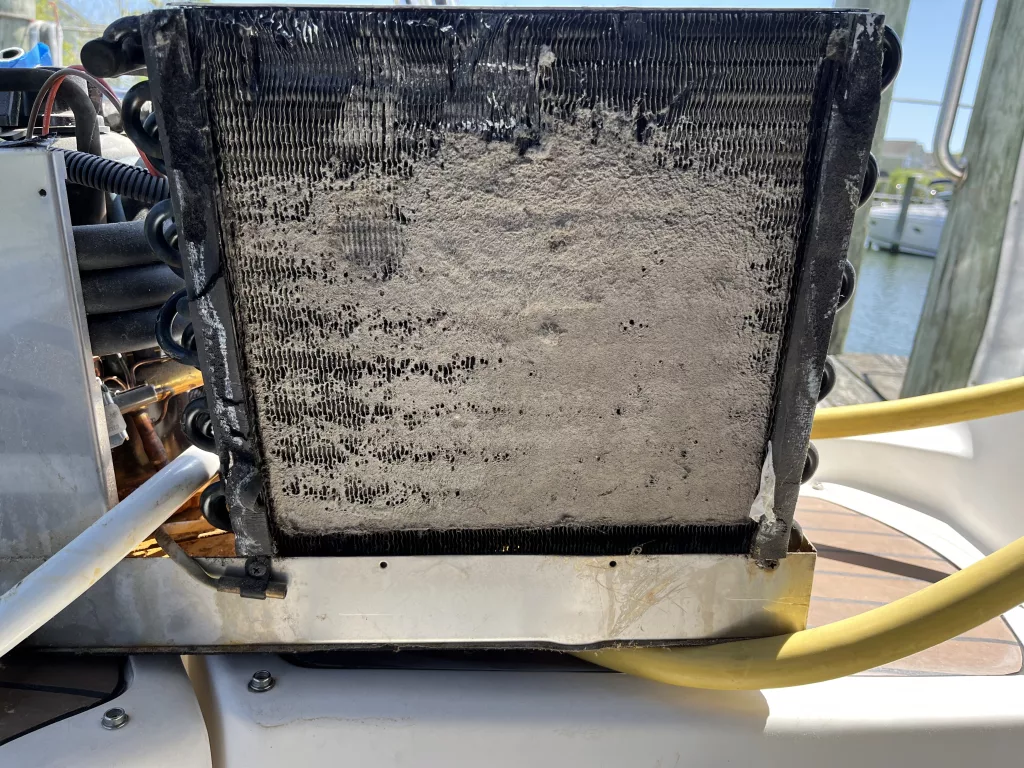
Even if your system is perfectly free of algae, there's a second invisible enemy: calcium carbonate scale. Calcium carbonate has a property called retrograde solubility — unlike most substances, it becomes less soluble in hot water. As seawater absorbs heat inside the condenser tubes, the calcium precipitates out and bakes onto the inner walls as a hard, white, bone-like crust.
Because calcium is a terrible conductor of heat, that crust acts like an insulating blanket. The pump pushes plenty of water, but the water can't absorb the heat through the calcium wall.
Trac Ecological outlines a process where you close the seacock, disconnect the intake hose, and drop it into a bucket of their descaling acid (Barnacle Buster). Turn the AC pump on just long enough to suck the acid into the entire system, then shut it off. Let the acid sit inside the hidden coils overnight. The acid chemically reacts with the calcium carbonate, dissolving it back into liquid without harming the underlying cupronickel metal. Flush it out the next morning and you restore heat transfer efficiency entirely back to factory specifications.
Pro Tip: We recommend annual acid descaling for every marine AC system in Southwest Florida. Our warm Gulf waters are mineral-rich, and scale buildup is accelerated by the high condenser temperatures during summer. Our AC Maintenance Program includes annual descaling as a standard service item.
The Electrosea Upgrade: Automated Chemical Warfare
For boaters who want the ultimate hands-off solution, the Electrosea system replaces your standard sea strainer with an electrified housing. It uses a low-voltage electrical current to separate salt molecules in the seawater, actively generating its own precisely monitored safe level of chlorine right at the intake point. It prevents any biological growth or scale from ever forming in the system. It requires a serious upfront financial investment, but when you weigh the cost of prevention against the cost of neglect, the perspective shifts.
The Cost of Neglect: A Cautionary Tale
A yacht owner docked in Miami decided to shut off the AC completely while away for a month to save on his shore power bill. Without the AC constantly pulling moisture out of the cabin air, the internal humidity spiked to nearly 100%. Mold bloomed everywhere. The expensive interior wall coverings completely debonded and peeled off the wood backing. The result: a $100,000 interior refit — simply because they failed to understand that marine air conditioning isn't just a luxury for human comfort. It is the fundamental life support system for the yacht's interior climate.
Schedule Your Sea Strainer Service
Whether you need a routine sea strainer cleaning, a full AC system diagnostic, pump replacement, or annual acid descaling, ACCUMAR Marine Services has the expertise. We service all major marine AC brands including Dometic, Marine Air, Webasto, Mermaid, and Cruisair throughout Fort Myers, Cape Coral, Naples, Marco Island, and all of Southwest Florida.
Q: How often should I clean my marine AC sea strainer in Fort Myers?
A: In Fort Myers and Southwest Florida's warm, nutrient-rich waters, we recommend a visual inspection every week and a full cleaning whenever you see debris accumulating. During peak summer months or after storms, you may need to clean it every 2-3 days. The official Dometic manual says monthly — most experienced captains consider that dangerously infrequent for Florida waters.
Q: What happens if I run my marine AC with a clogged sea strainer?
A: A clogged strainer restricts water flow, causing the AC to throw a high-pressure fault (HPF) or low-flow error. If the pump runs dry, the impeller generates intense heat without water cooling, melting the internal thermoplastic components. Back pressure can blow hose seals, flooding your bilge with saltwater. The cascade can escalate from a sweaty afternoon into a five-figure electrical refit.
Q: Can I use chlorine tablets instead of bromine in my sea strainer?
A: Absolutely not. Chlorine is far too aggressive for marine AC systems. It degrades plastic housings, destroys O-rings, and triggers severe galvanic corrosion in cupronickel heat exchangers. Bromine is equally effective at killing biological growth while being much gentler on plastics and metals. Use only 1-inch bromine spa tablets.
Q: What is cavitation and how do I fix an airlocked marine AC pump?
A: Cavitation occurs when a centrifugal pump spins in air instead of water — it can't create enough vacuum to pull water in. You'll hear a smooth hum but see no water discharge. To fix it: shut off power, close the seacock, open the strainer housing, pour fresh water in until it overflows into the intake hose, seal it back up, reopen the seacock, and restart. This manually displaces the air bubble.
Q: How much does marine AC sea strainer service cost in Southwest Florida?
A: A basic sea strainer cleaning and AC system check starts at our standard service rate. Annual acid descaling with Barnacle Buster typically runs $200-$400 depending on the number of AC units. Our AC Maintenance Program bundles strainer service, descaling, and full system inspections into a cost-effective annual plan. Call 239-323-9600 for a quote.
Share this article:
Comments
Leave a Comment
Need This Service?
ACCUMAR Marine Services provides expert Air Conditioning service throughout Southwest Florida. Mobile service to your dock.
Talk to Our Team
Have questions about this article or need advice for your specific situation? Call us directly for a free consultation.