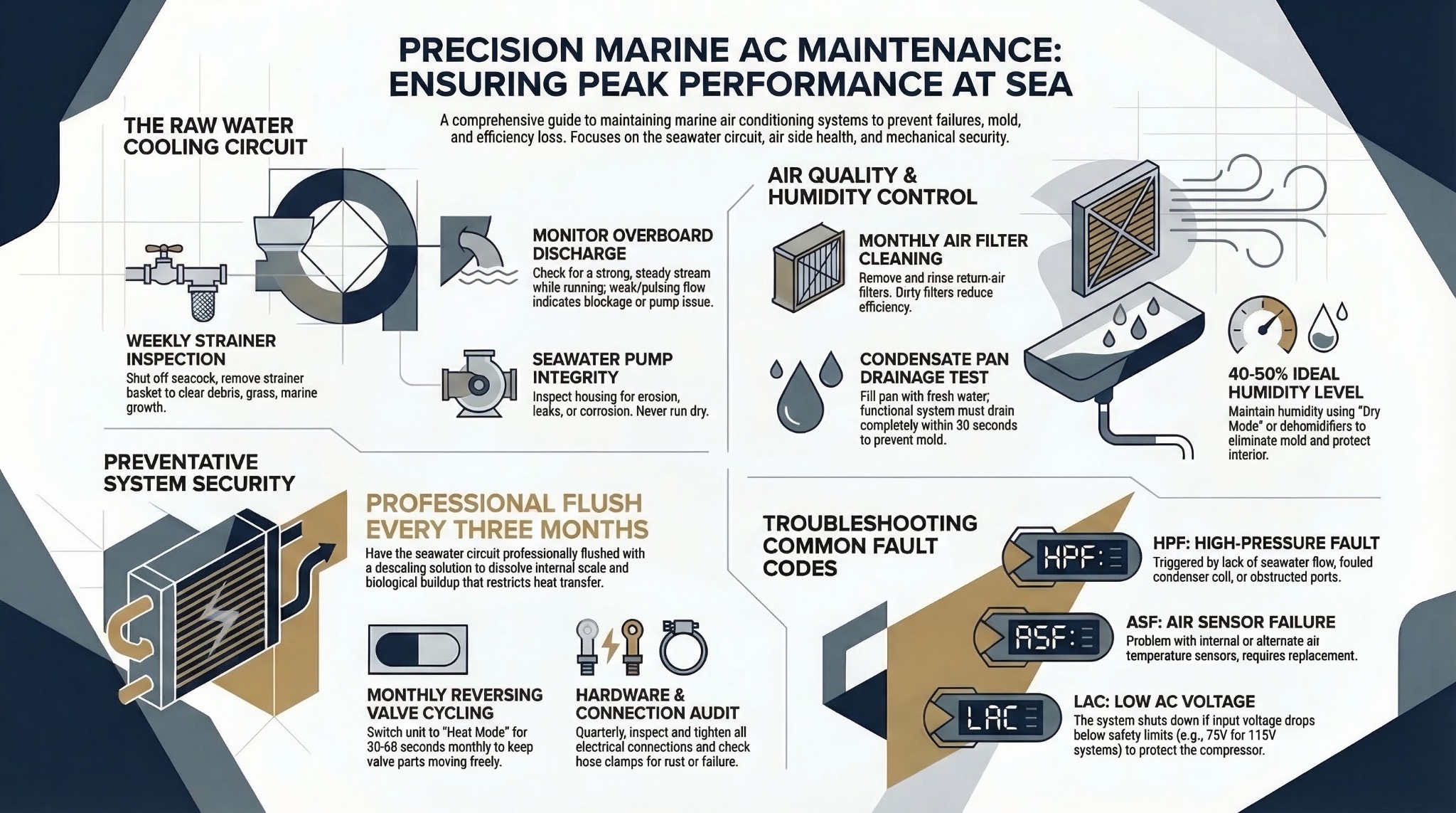
Summer in Southwest Florida means one thing for your boat's air conditioning: maximum stress. As seawater temperatures climb into the high 80s and ambient air pushes past 95°F, marine AC systems are forced to work harder than any other time of year. The result? High pressure faults — the single most common AC failure we see at ACCUMAR Marine Services from May through October.
If your marine AC unit is tripping on high pressure, shutting down mid-cycle, or blowing warm air, this guide explains exactly what's happening inside your system, why it's happening now, and what you need to do about it.
What Is a High Pressure Fault?
Every marine air conditioning system operates within a specific pressure range. The compressor pumps refrigerant through a closed loop — absorbing heat from your cabin air and rejecting it into the seawater flowing through the condenser (heat exchanger). When the discharge pressure on the high side of the compressor exceeds the manufacturer's safety threshold, the system's high pressure switch trips and shuts the compressor down.
This is a safety mechanism, not a malfunction. The switch exists to prevent catastrophic compressor failure, refrigerant line rupture, or worse. But when it keeps tripping, your AC is telling you something is seriously wrong with the heat rejection side of the system.
The #1 Cause: Fouled Condenser (Heat Exchanger)
In 25+ years of marine AC work across Fort Myers, Cape Coral, Naples, and all of Southwest Florida, the overwhelming majority of high pressure faults trace back to one root cause: a fouled condenser.
Here's the chain of events:
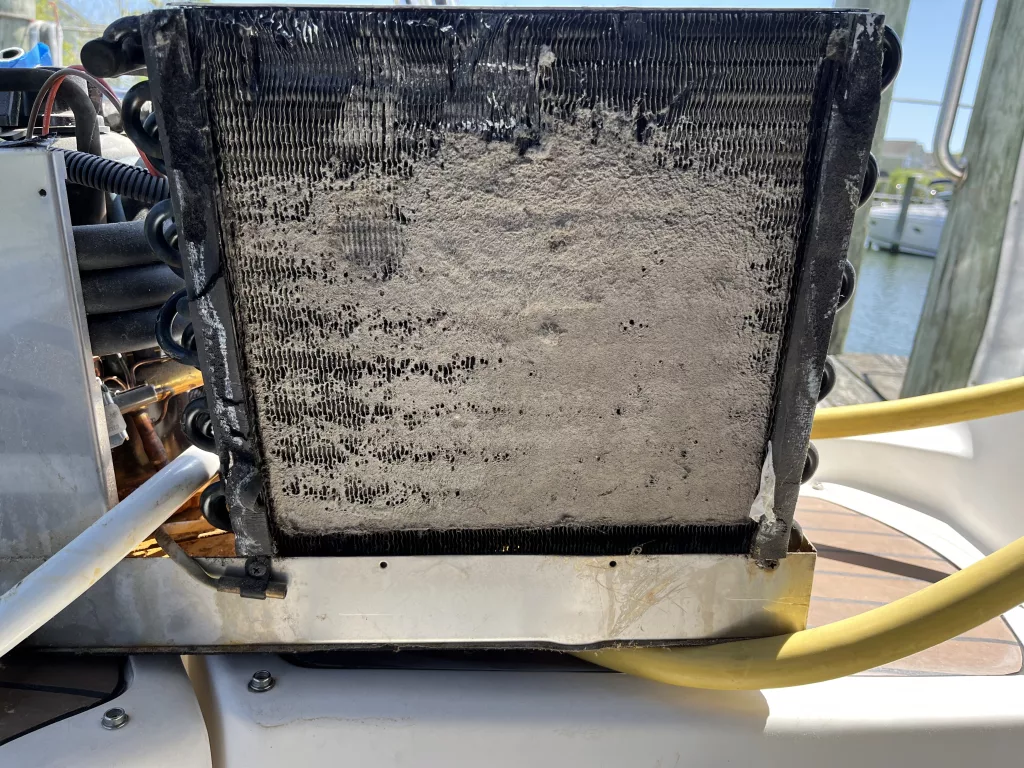
- Scale buildup — Calcium carbonate, magnesium, and other minerals in seawater gradually coat the inside walls of your condenser tubes. This insulating layer reduces heat transfer efficiency.
- Biofouling — Barnacle larvae, algae, and marine organisms colonize the condenser internals, further restricting flow and insulating the tubes.
- Reduced heat rejection — The refrigerant can't dump its heat into the seawater fast enough. Discharge pressure climbs.
- High pressure fault trips — The safety switch shuts down the compressor to prevent damage.
The warmer the seawater gets in summer, the less temperature differential exists between the refrigerant and the cooling water. A condenser that was "getting by" with moderate fouling in March will fail outright in July when seawater hits 87°F.
Other Common Causes of High Pressure Faults
Clogged Sea Strainer
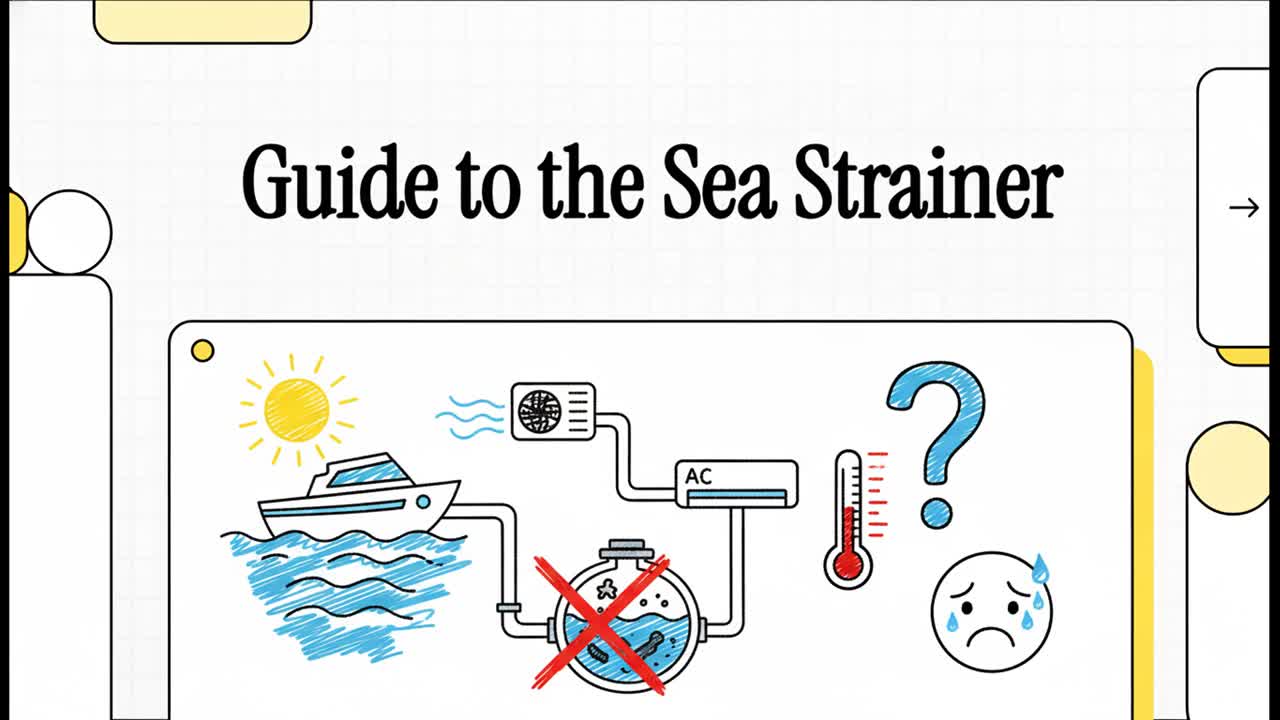
Your sea strainer is the first line of defense. If it's packed with seagrass, debris, or biogrowth, water flow to the condenser drops dramatically. Less water flow = less heat rejection = high pressure fault. This is the easiest fix — clean your strainer. We recommend checking it weekly during summer.
Failing Seawater Pump
The raw water pump (typically a March LC-3CP-MD or similar magnetic drive pump) pushes seawater through the condenser. A worn impeller, failing bearings, or air-locked pump will reduce flow below the minimum required for adequate heat rejection. If your pump is making unusual noise or the discharge water flow at the overboard fitting looks weak, the pump needs attention.
Blocked or Kinked Seawater Lines
Hoses that have collapsed internally, fittings clogged with scale, or thru-hull valves that aren't fully open will all restrict seawater flow. We've seen boats where a previous technician used undersized hose or added unnecessary 90° fittings that created enough restriction to cause chronic high pressure issues.
Overcharged Refrigerant
If someone added refrigerant without proper gauges or training, the system may be overcharged. Too much refrigerant in the loop raises discharge pressure above normal operating range. This requires a certified EPA technician to recover, measure, and recharge to manufacturer specifications.
Non-Condensable Gases (Air in the System)
If the system was opened for repair and not properly evacuated before recharging, air and moisture trapped in the refrigerant loop will cause abnormally high head pressure. The only fix is a full recovery, vacuum, and recharge.
The Fix: Cooling System Flushing (Descaling)
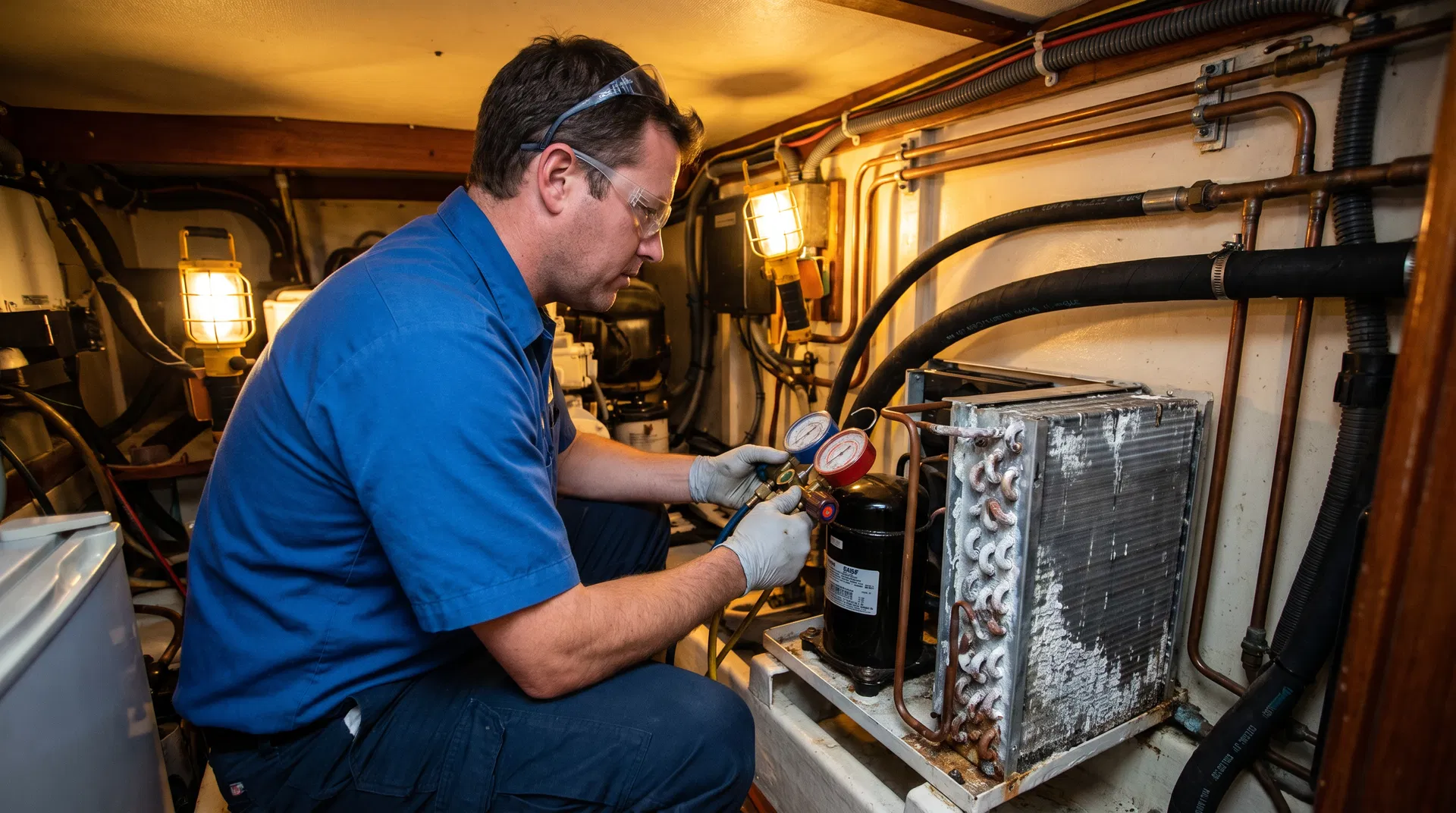
For the majority of high pressure fault cases, the solution is a complete cooling system flush — also called descaling or acid cleaning. This is a service ACCUMAR Marine provides on-site at your marina or dock.
What's Involved
- Isolate the seawater circuit — Close the seacock and disconnect the seawater lines from the condenser.
- Connect the flushing rig — We use a dedicated circulation pump and bucket to create a closed-loop flushing circuit through the condenser.
- Circulate descaling solution — We use ACCUMAR Descaling Solution (or Barnacle Buster / Rydlyme for specific applications) — a biodegradable acid that dissolves calcium carbonate, mineral scale, and barnacle deposits without damaging copper, cupronickel, or titanium heat exchangers.
- Monitor the reaction — Active scale dissolution is visible as foaming and bubbling in the bucket. We circulate until the reaction stops — typically 30-60 minutes for moderate fouling, up to 2 hours for severely neglected systems.
- Flush with clean water — Neutralize and flush the entire circuit with fresh water to remove dissolved deposits and residual acid.
- Reassemble and test — Reconnect seawater lines, open the seacock, verify pump flow, and run the system while monitoring pressures to confirm the high pressure fault is resolved.
What You'll See After a Proper Flush
- Discharge pressure drops back to normal operating range (typically 200-275 PSI for R-410A systems, 150-225 PSI for R-22 systems)
- Seawater discharge temperature at the overboard fitting increases (meaning the condenser is actually transferring heat again)
- Cabin cooling improves dramatically — often by 5-10°F at the vent
- Compressor run time decreases (the system doesn't have to work as hard)
- No more high pressure fault trips
How Often Should You Flush?
For boats kept in Southwest Florida waters year-round:
| Usage Level |
Recommended Flush Interval |
| Heavy use (liveaboard, charter, daily use) |
Every 6 months |
| Regular use (weekends, seasonal cruising) |
Annually — ideally before summer |
| Light use (occasional, stored at dock) |
Annually — stagnant water accelerates fouling |
| After a high pressure fault |
Immediately — don't keep resetting the switch |
Pro tip: Schedule your flush in April or early May, before the summer heat arrives. By the time seawater temperatures peak in August, a freshly descaled condenser will handle the load without breaking a sweat. Waiting until July when the system is already tripping means you're competing with every other boat owner for service appointments.
Can You DIY a Condenser Flush?
Yes — if you're mechanically inclined and comfortable working with seawater plumbing. You'll need:
- A 5-gallon bucket
- A small submersible or utility pump (we use a 350 GPH pump)
- Two lengths of hose with appropriate fittings
- ACCUMAR Descaling Solution (1 gallon for most single-unit systems)
- Safety glasses and gloves
The process is straightforward: close the seacock, disconnect the seawater inlet and outlet from the condenser, connect your pump and bucket in a loop through the condenser, add the descaling solution, and circulate for 30-60 minutes. Flush with fresh water when done.
However, if you're also experiencing refrigerant-side issues (overcharge, non-condensables, low charge from a leak), those require EPA-certified technicians with proper recovery equipment. That's where we come in.
When to Call ACCUMAR
Call us if:
- Your AC keeps tripping on high pressure even after cleaning the sea strainer
- You've never had the condenser flushed (or it's been over a year)
- The seawater pump sounds weak or the overboard discharge is barely flowing
- You suspect refrigerant issues (the system was recently opened or serviced elsewhere)
- You want it done right the first time before summer hits
We provide mobile on-site service throughout Southwest Florida — Fort Myers, Cape Coral, Naples, Fort Myers Beach, Punta Gorda, and everywhere in between. Our technicians carry descaling solution, flushing rigs, refrigerant gauges, and replacement pumps on every service call.
Schedule Your AC Flush Before Summer
Don't wait for the high pressure fault. Preventative descaling is faster, cheaper, and keeps you cool all season.
(239) 323-9600
ACCUMAR Marine Services · Fort Myers, FL · Serving all of SWFL
Related Resources